

If you’re trying to hire salespeople in Florida right now, you’ve already figured out something’s different. The roles that used to fill in a month are taking three. The candidates who used to accept your offer are asking for more. The people who do say yes are getting poached six months later.
Florida’s sales hiring market has changed. Here’s what’s actually going on and what it means for your next hire.
The labor pool has grown but the good reps haven’t
Florida’s population growth is real. People keep moving here from New York, California, Illinois, New Jersey. A lot of them work in sales. In theory, that should make hiring easier.
In practice, it hasn’t. The overall labor pool is bigger but the pool of proven B2B sales talent isn’t growing at the same rate. A lot of the transplants are in real estate, financial services, or retail. The enterprise SaaS rep, the industrial sales rep, the legal tech specialist: those are still rare in Florida, and every company is fighting over the same shortlist. We wrote about the broader version of this shortage in America’s next top talent.
Remote reshuffled everything
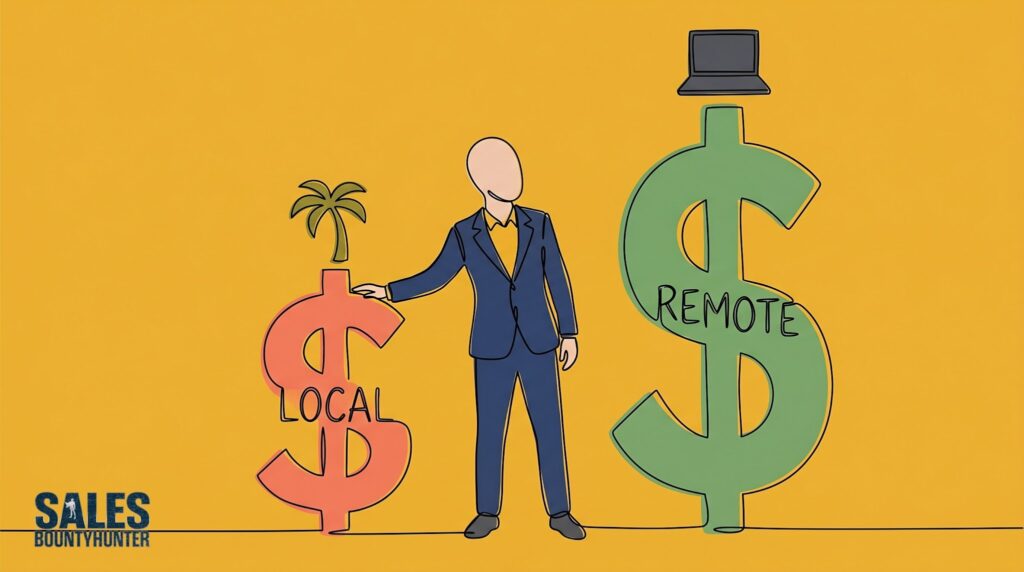
The other big shift: Florida sales pros now have national options. A rep based in Miami can take a role at a company headquartered in San Francisco or New York, at a salary that accounts for those markets. That’s raised the wage floor for everybody.
Local Florida employers who used to compete on Florida wages are now effectively competing on national wages. If you’re trying to hire a senior sales rep for $120K base plus commission, you’re losing candidates to remote roles paying $160K base. That math has to change or your searches won’t close.
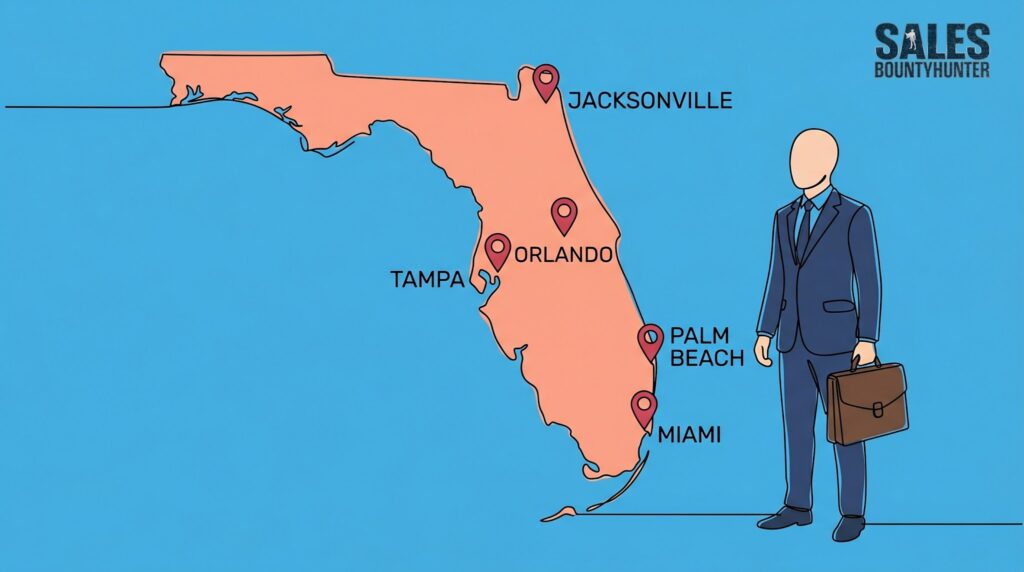
The cities have different markets
Florida isn’t one market. It’s several.
- South Florida (Miami, Fort Lauderdale) is the most competitive. Tech, fintech, healthcare, real estate: everything is hiring. Bilingual (Spanish) reps are in especially short supply relative to demand. Expect to pay.
- Tampa Bay is the fastest-growing professional services market in the state. Software, insurance, logistics, financial services. The talent pool has deepened a lot in the last three years but so has demand. Moderately competitive.
- Orlando has historically been hospitality-heavy but the tech and defense sectors are growing fast. There’s actually some slack here for traditional B2B sales roles. If your role isn’t hospitality-adjacent, Orlando can be a decent place to find people.
- Jacksonville is underrated. Lower competition, solid talent pool, lower cost of living. If you can find a rep there, they often stay longer than in other Florida markets.
The rest of the state (Gainesville, Tallahassee, Fort Myers, Palm Beach, Sarasota, the Keys) each have their own dynamics. Palm Beach has seen a big wave of hedge fund and wealth management growth. Naples and Sarasota are quietly attracting tech companies following the money. Don’t assume Florida is one market. The legal side of this looks even more localized, which is part of what to expect when working with a legal recruiter in Florida.
What candidates are asking for
The conversations with candidates have shifted in the last year.
The asks we hear most often:
- Compensation that matches the national remote market. Candidates know what they could make at a company headquartered elsewhere. Florida-specific comp ranges are a losing strategy unless everything else about your role is exceptional.
- Flexibility on remote or hybrid work. Not always fully remote, but at minimum a flexible hybrid. Full in-office Monday through Friday filters out most candidates before you even talk to them.
- A real plan for growth. The best reps aren’t looking for a job. They’re looking for a trajectory. If you can’t articulate what year two, three, and four look like for the person you’re hiring, they’ll find a company that can.
- A product they believe in. Florida’s pool of great reps has enough options that they can afford to be picky about what they’re selling. A mediocre product with a great comp plan is a harder sell than it used to be.
What’s working for employers
Clients who are hiring successfully right now are doing a few things differently.
They’re compensating competitively for the national market, not the local market, at least for senior roles. They understand that they’re competing with remote jobs whether they want to be or not. The cost equation here is worth understanding, which is why we broke down what a bad hire actually costs your business.
They’re moving fast. From first conversation to offer, the best employers close in under four weeks. The ones dragging out a 10-week process are losing candidates mid-way.
They’re hiring for trajectory, not just quota. They talk to candidates about where the company is going and where the role could lead. Generic “crush your quota” pitches don’t land with senior reps anymore. Being specific about what to look for when hiring a salesperson is a big part of getting this right.
They’re investing in employer brand at a local level. They’re visible at Florida sales events. They post real content from their sales team on LinkedIn. They make their company a known quantity in their local market instead of another anonymous logo.
What’s not working
The failing strategies are pretty consistent:
- Posting the role and waiting. If you’ve tried this, you know. The best candidates don’t apply.
- Holding the comp line below market. Every dollar you save on base comes back to you in longer vacancies, higher turnover, and lost revenue. The math almost never works.
- Dragging out the interview process. Seven rounds over six weeks is a way to lose every decent candidate you source.
- Treating Florida as one homogeneous market. What works in Miami doesn’t work in Jacksonville. Adjust your approach.
Where this is going
Our read on the next 12 months: the Florida market stays competitive but stabilizes. Wage growth slows from the 2022-2024 surge but doesn’t reverse. Remote/hybrid becomes the new baseline rather than a benefit. Employers who’ve adjusted their playbook continue to hire well. Employers still running a 2019 hiring process continue to struggle.
If you’re hiring sales talent in Florida
We place sales professionals across the state every week and we’re happy to talk about what’s working right now in your specific market. Sometimes the right move is running a traditional search. Sometimes it’s a completely different approach. Either way, knowing what you’re walking into saves you months.