

You’ve had a role open for a while, and you’re starting to wonder: is this normal? Should it really take this long? Are we doing something wrong?
The honest answer is: it depends. A receptionist role and a senior attorney role are not going to take the same amount of time. But there are reasonable benchmarks, and if you’ve blown past them, there’s usually a reason. Here’s what to expect and how to tell if your search is stuck.
The national averages, roughly
Most hiring data puts the average time-to-fill at about six to eight weeks for a white-collar role. That’s across industries, across role types, across company sizes. It’s a rough average.
Higher-complexity roles take longer. Senior positions, specialized technical roles, and leadership hires typically run 10 to 16 weeks. Executive searches can take six months.
Lower-complexity roles move faster. An entry-level sales role or a support position should close in three to five weeks if you’re running an active search.
If your search is significantly outside those ranges, something’s off.
What should happen in each phase
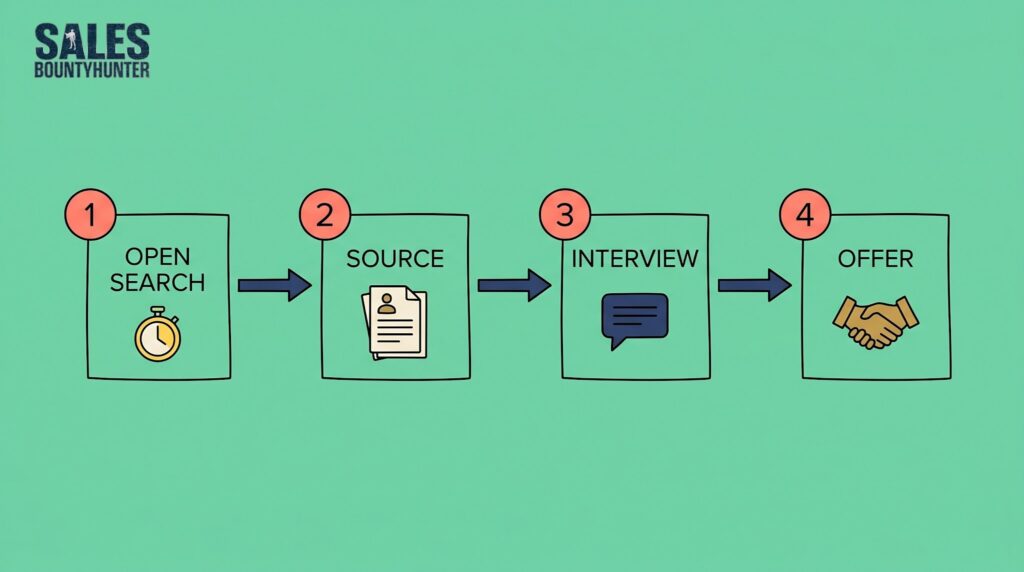
Most hiring processes break down into four phases, and knowing where the time goes helps you spot the bottleneck.
- Opening the search (week 1). This is where most firms bleed time they shouldn’t. Write the job description, agree on the hiring panel, get budget approved, post the role. This should take a week. It often takes three because nobody prioritizes it.
- Sourcing and screening (weeks 2-4). A good search should be producing qualified candidates within two weeks of opening. If you’re four weeks in and haven’t talked to anyone worth interviewing, your sourcing channels are wrong, or the role itself needs to be re-scoped.
- Interviewing (weeks 3-6). First-round interviews, follow-up interviews, panel conversations. This should compress, not stretch out. Every week a candidate sits in your process is a week they could accept a competing offer. Sharpening your question set with something like these 10 sales interview questions goes a long way toward compressing this phase.
- Offer and close (weeks 5-8). Reference checks, offer negotiation, accepting the offer, starting. Two weeks is normal. More than three means something’s wrong on either side.

The signs your search is stuck
Here’s what usually goes wrong:
- You’re not getting qualified applicants. If two weeks in you have 40 resumes and none of them are right, the job posting is the problem. Either the requirements don’t match the market, the compensation is off, or the posting isn’t reaching the right people.
- You keep interviewing but not deciding. This is the most common form of paralysis. You’re seeing candidates, they’re fine, but nobody feels like a clear yes. Usually this means one of three things: you don’t actually know what you’re looking for, you’re holding out for perfection, or the best candidates are being lost to slower decision-making. Our post on what to look for when hiring a salesperson can help you get clearer on your bar.
- Candidates keep dropping out. If good candidates are pulling themselves out of your process, it’s usually one of two things. Either your process feels disorganized from their side, or a competitor is moving faster and closing them before you.
- The same person keeps getting vetoed. If your hiring panel keeps disagreeing about the same candidate types, you have an internal alignment problem. More interviews won’t fix it. A conversation will.
The fixes that actually work
- Re-scope the role. If you’ve been searching for four months, it’s time to ask whether the role as defined is hireable. Sometimes the right move is splitting it into two jobs. Sometimes it’s adjusting the seniority level. Sometimes it’s raising the compensation.
- Cut the interview rounds. Most firms use too many interviews. If your process has six rounds, you’re losing candidates to faster firms. Three to four rounds is plenty for most roles.
- Decide faster. The single biggest unforced error in hiring is slow decision-making. When you find someone you like, move. Don’t wait three weeks to compare them to three more candidates. The three more candidates will often disappear, and so will the one you liked.
- Get help with sourcing. If your problem is that qualified people aren’t in your pipeline, you need someone doing outreach to people who aren’t applying. That’s the work that doesn’t happen on a job board, and it’s usually when it makes sense to hire a headhunter.
When 90 days is too long
If a role’s been open 90 days, the cost is no longer just the open position. It’s the burnout on the team picking up the slack. It’s the projects that aren’t getting done. It’s the revenue that isn’t coming in. At some point the cost of the vacancy exceeds the cost of making a decision, and what a bad hire actually costs your business is a useful lens for running that math.
We see this constantly with clients who come to us after running their own search for four months. The role hasn’t changed. The pool hasn’t changed. What’s changed is that they’re now willing to move faster than they were.
If your search has stalled and you want to talk through what’s actually blocking it, we’re happy to have that conversation. Sometimes you need a new approach. Sometimes you just need someone to tell you honestly why it’s been stuck.